Pricing
Make Pricing Explained (2026): Credits, Plans, and What Three Real Workflows Actually Cost
Some links below are affiliate links. If you buy through them we may earn a commission at no extra cost to you. How we make money.
Pricing checked October 16, 2026 from make.com/en/pricing, make.com/en/compare/make-vs-zapier, and Make Help Center pages on credits and extra credits. Make changes pricing; check the live page before you buy.
Make's sticker price ("Core from $9/month") looks cheaper than Zapier at a glance. What you actually pay depends on how many credits each scenario burns, whether you poll or use webhooks, and what happens when you run out. This guide walks through each piece, then prices the same three small-business workflows we built on October 12, 2026.
Short version:
- Make charges per credit. Most module actions use 1 credit. Router and error-handler modules use none (Make pricing).
- Free gives you 1,000 credits/month. Paid plans start at 10,000 credits: Core $9/mo, Pro $16/mo, Teams $29/mo billed annually ($10.59, $18.82, and $34.12 billed monthly), checked on Make's pricing and compare pages October 16, 2026.
- Sleep counts as a credit, and a single scenario's run is capped at 5 minutes on the plan we tested — so a 2-hour "wait then email" job needs a different design.
- If you run out of credits, scenarios stop until you buy more or upgrade. Extra credits cost 25% more than your plan's per-credit rate (Make Help).
- For the three workflows we measured (~1,290 credits/month at our assumed volumes), Core at $9/mo annual is enough, with a lot of headroom.
How Make pricing works: plan + credits
Every Make subscription has two parts (Make):
- A plan level (Free, Core, Pro, Teams, or Enterprise), which decides features.
- A credit allowance, which is how many module actions you can run. Paid plans start at 10,000 credits and scale up from there.
The plans (10,000-credit starting tier)
| Plan | Billed annually | Billed monthly | Credits | Best for |
|---|---|---|---|---|
| Free | $0 | $0 | 1,000 / month | Learning and light volume |
| Core | $9/mo | $10.59/mo | From 10,000 | Solo operators on a budget |
| Pro | $16/mo | $18.82/mo | From 10,000 | Heavier use, more advanced features |
| Teams | $29/mo | $34.12/mo | From 10,000 | Several people sharing scenarios |
| Enterprise | Custom | Custom | Custom | Security, SSO, SLAs |
Sources: Make pricing and Make vs Zapier compare, checked October 16, 2026. Dollar amounts for Core/Pro/Teams at the starting 10,000-credit tier match Make's published comparison table ($9 / $16 / $29). Monthly figures ($10.59 / $18.82 / $34.12) match our October 12, 2026 browser check of the pricing page and Make's own extra-credits example, which uses a "$9 plan" with 10,000 credits.
You can buy a larger credit package on paid plans; the sticker price scales with the tier. We focus on the 10,000-credit entry point because that is where most small businesses land.
Annual vs monthly credits (easy to miss)
On a monthly subscription, you get a fresh credit allotment each billing month.
On an annual subscription, Make prepays a bulk of credits for the year on Pro and Teams, and you can use them flexibly across the year. Core is different: even on annual billing, Core credits still reset monthly (Make Help: monthly and annual subscriptions).
Unused credits expire at the end of the term (Make pricing FAQ).
What counts as a credit (and what doesn't)
This is where people mis-estimate the bill. Per Make and Make Help on credits:
Counts (usually 1 credit per operation):
- Reading, searching, creating, updating, or deleting data in an app
- Webhook / trigger modules that process data
- Transform tools (Set variable, aggregators, iterators, and similar)
- Sleep — it is a counted module in our builds
- Most third-party AI app modules (1 operation = 1 credit; you may also pay the AI vendor for tokens)
Does not count:
- Router modules
- Error-handler modules (Rollback, Break, Resume, Commit, Ignore)
- Route filters on the links between modules (confirmed in our Workflow 1 build: the ZIP "starts with 97" filter used 0 credits)
AI caveat: Make's own AI Provider and some built-in AI tools can burn variable credits based on tokens and other factors (Make Help). We did not measure AI modules in our October 12 builds. Treat AI steps as a separate budget until you watch a few runs.
Polling vs webhooks: a scenario that checks an app on a schedule still spends credits on the trigger module even when nothing new shows up. Instant webhooks only spend credits when data arrives. For lead forms and "job completed" events, webhooks are the cheaper design.
Practical rule of thumb: count every module that runs, including Sleep and Set variable. Subtract Routers, error handlers, and link filters. That is your credits per run.
What happens when you run out of credits
Make does not quietly keep going like Zapier's optional pay-per-task mode. Per Make pricing:
- Scenarios stop until credits are added again.
- Incoming webhooks queue up to your webhook queue limit, then process when credits return.
- Polling scenarios look for records since the last successful run once credits are back.
- Options: upgrade the plan, buy extra credits in 1,000 or 10,000 bundles, or turn on extra credits auto-purchasing (buys 10,000 at a time on Core/Pro/Teams).
Extra credits cost 25% more than your plan's included per-credit rate. Make's own example: on a $9 / 10,000-credit plan, one credit is $0.0009, so 1,000 extras cost $1.125 and 10,000 extras cost $11.25 (Make Help: extra credits).
For a lead-intake scenario, stopping is bad: leads sit in the queue. Size the plan with headroom, or enable auto-purchasing with a spending cap you can live with.
What we measured: three workflows, real credit counts
On October 12, 2026 we built the same three workflows in Make on a Free plan account (1,000 credits/month). Full build notes are in Make vs n8n vs Zapier. Here is only the billing math, with volumes a 5-person home-services shop might see.
Workflow 1: New lead → check ZIP → store → email stand-ins
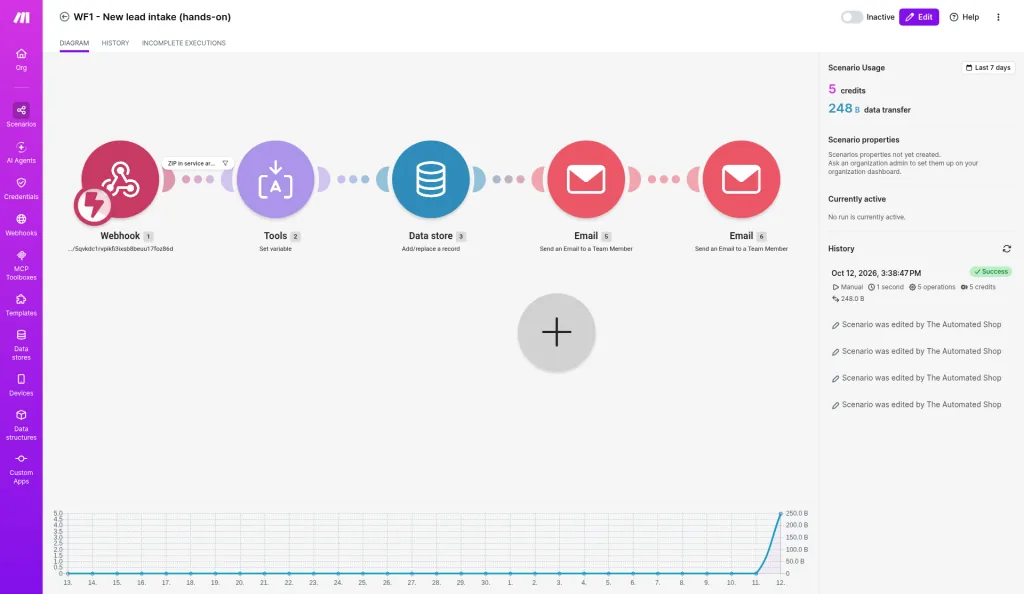
Trigger: webhook. Modules we ran: Webhook → Set variable → Data store → Email → Email, plus a free ZIP filter on the first link.
| Measured | |
|---|---|
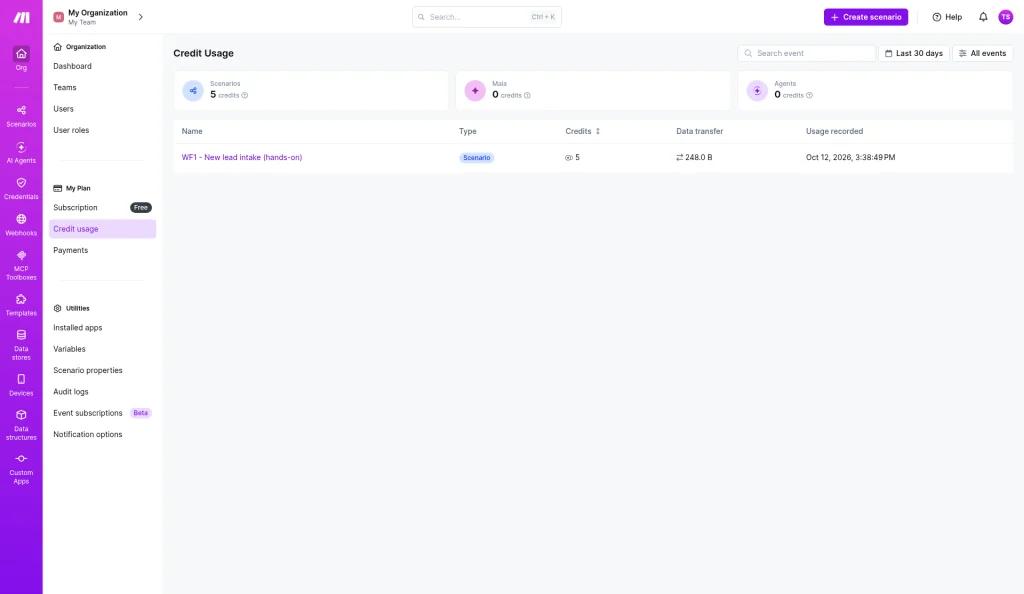
| Credits per lead | 5 (run history: 5 operations, 5 credits, 1 second) |
| At 150 leads/mo | 750 credits |
| Free plan after one run | 995 / 1,000 left |
Workflow 2: Job completed → wait → review request
Modules: Webhook → Sleep → Email → Email. We used Sleep at 300 seconds (Make's max) as a stand-in for a 2-hour wait.
| Measured | |
|---|---|
| Credits per job (full run) | 4 (webhook + Sleep + 2 emails) |
| At 120 jobs/mo | 480 credits |
| 2-hour wait in one scenario? | No — hit "MAXIMUM EXECUTION TIMEOUT [5 minutes]"; run status Warning even though emails completed |
Sleep is not free. A real 2-hour delay needs a different pattern (queue + scheduled scenario), which we did not build. That redesign may change the credit count.
Workflow 3: Weekly overdue-invoice sweep (10 invoices)
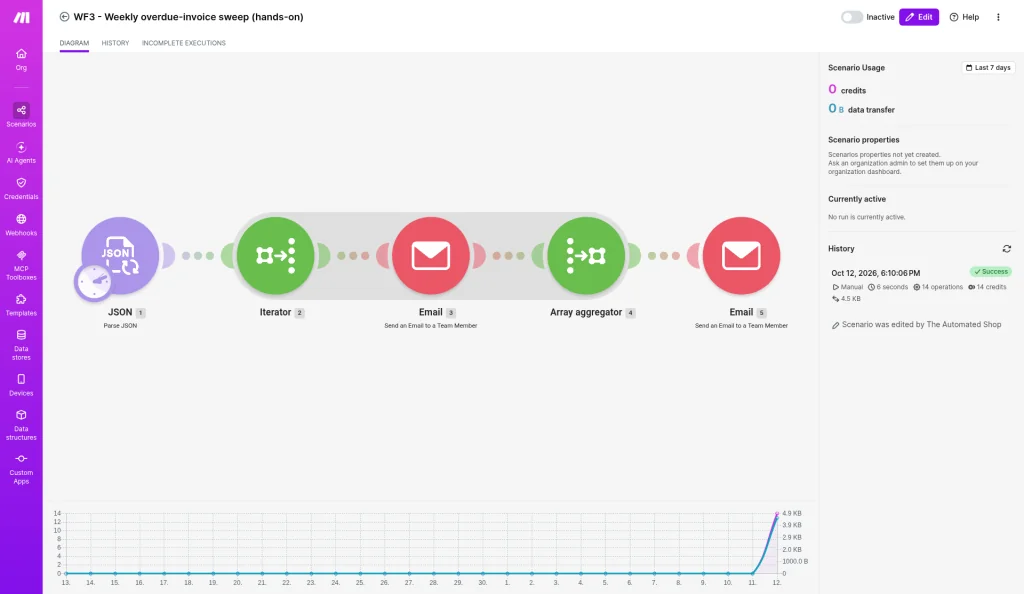
Modules: Parse JSON → Iterator → reminder Email (once per invoice) → Array aggregator → summary Email.
| Measured | |
|---|---|
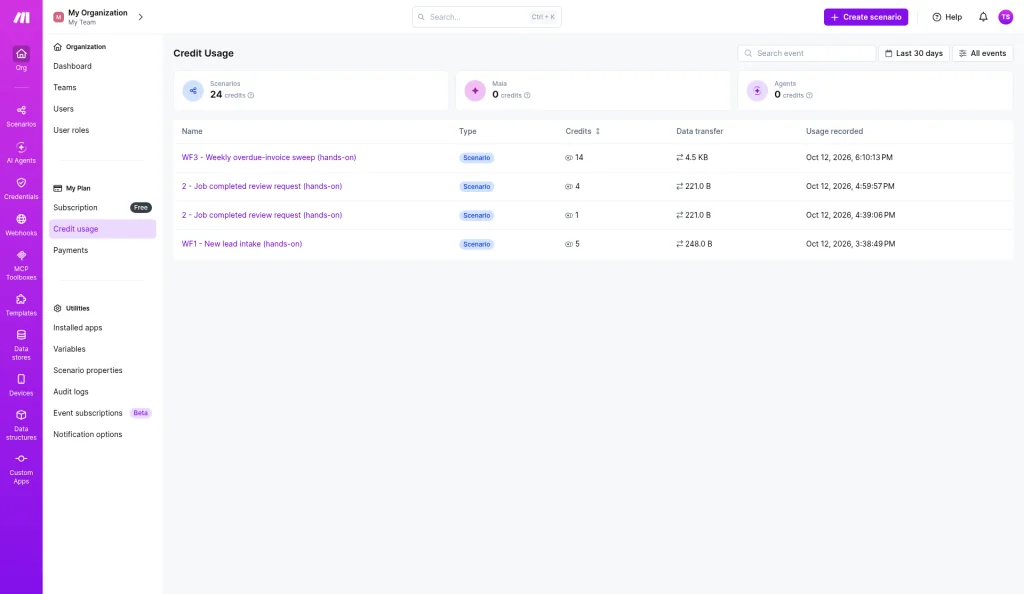
| Credits for 10 invoices | 14 (formula: N + 4) |
| At ~4.3 runs/mo | ~60 credits |
Monthly total for all three
| Workflow | Assumed volume | Credits/mo |
|---|---|---|
| New lead | 150 leads | 750 |
| Review request | 120 jobs | 480 |
| Invoice sweep | ~4.3 weeks × 10 invoices | ~60 |
| Total | ~1,290 |
That sits above Free (1,000) and well under Core (10,000). Plan needed: Core, $9/mo annual or $10.59 monthly, with about 8,700 credits of headroom at this volume.
Caveats we will not paper over: volumes are assumptions. Builds used Make's "Send an Email to a Team Member" stand-in instead of SMTP/SMS/Slack/CRM apps, so a production scenario may add or remove modules. We left every scenario Inactive after testing. Polling costs were not measured.
Worked examples: three small-business bills
These combine official prices with our measured per-run credits (or the same counting rules). They are models, not invoices from customer accounts.
Example 1: Solo consultant, light lead capture
- Scenario: webhook → Data store → one team email. 3 credits per lead (same counting rules as our builds; not a separate timed build).
- Volume: 40 leads/month = 120 credits.
- Cost: $0 (Free), with 880 credits left. Free also capped us at one 1 MB data store in testing — enough for a single lead table, not a second store.
Example 2: Home-services company, 5 people (our three workflows)
- Measured mix above: ~1,290 credits/month.
- Cost: Core $9/mo annual ($10.59 monthly).
- Same work on Zapier, using the billable-step counts from our Zapier pricing guide and comparison build, lands around the Pro 750-task tier at $19.99/mo annual — more than double Make's Core sticker for this volume.
Example 3: Agency looping hard
- One weekly report that emails 200 clients individually, plus parse/iterate/aggregate/summary scaffolding: roughly N + 4 = 204 credits per run × 4.3 ≈ 880 credits/month for that scenario alone.
- Add a few lead and ops scenarios and you can still fit Core. The pain is not the plan price — it is that each item in a loop is a credit, while n8n would bill one execution for the whole run. Details in our comparison.
Use the free calculator template at the top of this page to plug in your own scenarios.
Free plan limits we hit in testing
Beyond the 1,000-credit cap, two Free-plan limits showed up in our builds:
- Active scenarios: the UI showed 0 / 2 active scenarios. Multi-step scenarios with filters still ran manually on Free; we left them Inactive.
- Data store storage: creating a second data store failed with "Not enough space in storage." Make's pricing FAQ ties storage to credits (1 MB per 1,000 credits, and each data store needs at least 1 MB), so Free effectively gets one data store. We used a second team email as a log instead.
Paid plan feature matrices (minimum scheduling interval, priority execution, seat rules) change on Make's pricing page — verify there before you upgrade for a specific feature rather than for credits alone.
Is annual billing worth it?
At the 10,000-credit Core tier: $9 × 12 = $108/year versus $10.59 × 12 ≈ $127/year monthly. That is a modest discount, but Core's credits still reset monthly even on annual billing, so you are not banking a yearly pile the way Pro/Teams annual customers can (Make Help).
If your volume is spiky, remember: running out stops scenarios. Buying extras at +25% is worse than picking a credit tier with headroom.
Make also advertises a Start-up Plan (under 20 employees, 50% off Business) on its pricing page — worth checking if you qualify (Make).
When Zapier or n8n is the better buy
Make wins on price per unit for multi-step scenarios at small-business volume. It loses when:
- You need a long wait inside one run. Our Workflow 2 hit the 5-minute ceiling. Zapier's Delay and n8n's Wait both accepted 2 hours in our tests (comparison).
- Your workflows loop over many items. Make charges per module per item; n8n Cloud charges per execution. Our 10-invoice sweep: Make 14 credits, n8n 1 execution, Zapier 20 tasks (measured on Zapier's plan counter).
- You need an obscure app only Zapier lists among its 9,000+ integrations (Zapier). Make lists 1,000+ / 3,000+ depending on the page; depth per app is often strong, but breadth still favors Zapier.
- Nobody wants to learn Routers and data structures. Zapier's editor is faster for simple linear Zaps; our Workflow 1 build times were close (~21–25 minutes), but Make's mapping editor garbled typed formulas until we used the picker pills.
Stay on Make if you want the lowest bill for branching, multi-step work under ~10,000 credits/month and you can design around the 5-minute run limit.
Look at Zapier if ease and app coverage matter more than the extra ~$11/mo at this volume. Full breakdown: Zapier pricing explained.
Look at n8n if loops and long waits dominate. Cloud Starter is €20/mo billed annually (n8n, checked October 16, 2026); Community Edition is free if you self-host.
FAQ
Does Make have a free plan? Yes: 1,000 credits per month, not time-limited (Make).
What is the cheapest paid Make plan? Core at the 10,000-credit tier: $9/mo billed annually or $10.59/mo billed monthly (October 16, 2026 check).
Do filters use credits? Link filters did not in our Workflow 1 build. Router modules are free per Make's pricing FAQ. Ordinary modules, including Sleep and Set variable, do use credits.
What happens if I hit my credit limit mid-month? Scenarios stop until you upgrade, buy extras (+25%), or wait for the next allotment. Webhooks can queue up to your plan's queue size.
Can I cancel anytime? Yes. Paid access continues through the end of the current monthly or annual term, then the organization moves to Free (with Make's stated caveat if you already own another Free organization) (Make).
Does The Automated Shop earn a commission if I subscribe to Make? We apply to affiliate programs as they approve us. Until a tracking link is live, links on this page go to Make's official site with no referral tag. See our affiliate disclosure.